
Leaders risk distrust through culturally rigid behaviour
INSEAD’s Andy Yap says modern leadership now depends on adaptability, trust, and cultural awareness.
Companies risk weakening employee trust, collaboration, and cross-border management effectiveness as outdated ideas about executive presence fail to match modern workplace expectations.
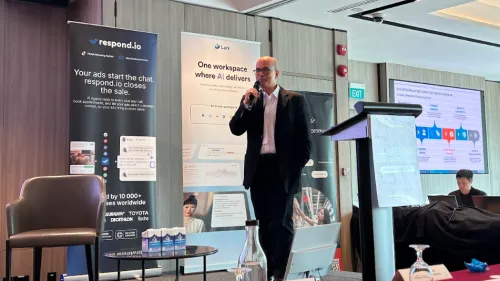
In an interview with Andy J. Yap, Associate Professor of Organisational Behaviour and Academic Director at INSEAD’s Centre for Organisational Research, he highlighted that many executives still wrongly believe leadership presence is an inborn trait tied to dominance, confidence, or appearance rather than a skill that can be developed and adjusted across different business environments.
According to Yap, leadership communication has become more important as managers oversee multicultural teams across hybrid workplaces, digital platforms, and international business settings where behaviour can be interpreted differently.
“But what we know is that it's something teachable,” he said. “Once you can identify the elements of executive presence, how do you signal competence in an authentic way? How do you signal warmth?”
Yap argued older leadership styles built around hierarchy and authority are becoming less effective in workplaces that increasingly depend on collaboration, psychological safety, and cultural awareness.
“We hear of stereotypes of what leaders should be, and in the 80s and 90s, people often talked about dominance, showing confidence, a deep voice and all that,” Yap said. “But that won't work in today's climate.”
The discussion also examined how INSEAD is using virtual reality and artificial intelligence to improve behavioural training for executives. Yap said traditional coaching methods often struggle to balance realism with scalability across large organisations.
“VR allows me to have both and deal with it in a way that allows me to scale,” Yap said.
According to Yap, immersive learning environments help executives better understand emotional reactions, personal space, and communication behaviour during leadership interactions.
“So with the VR experience, you don't just see it, you feel it,” he said.
Yap also warned leaders against confusing adaptability with inauthenticity. He argued executives should remain consistent in values whilst adjusting behaviour depending on culture, audience, and business situations.
“In my culture, we don't shake hands. You bow,” Yap said. “That's not that I don't trust you, but that's a poor understanding of culture.”
Yap said companies that fail to modernise leadership development may struggle with employee engagement, collaboration, and managing increasingly global workforces.









![[Singapore Business Review] Report on the Asian Business Channel](https://www.cmgassets.com/s3fs-public/styles/video_thumbnail/public/2026-10/full-show-thumbnail_1.png.webp?VersionId=bJbrT_JKOuMWBnf7YkmsWjOSWIXddSvY&itok=zWuxHRNG)










 Read Here
 Advertise
 Sign Up






Commentary
When scale arrives before proof: Singapore’s capital allocation question in Southeast Asia
Rethinking fleet ownership in a changing business landscape
Beyond the chips: The materials behind Singapore’s AI infrastructure
How homegrown brands are redefining premium in Asia
AI in hospitality: Where should Singapore’s F&B operators draw the line?
Do Singapore workplaces mistake silence for leadership?
AI as the new competitive advantage for Singapore’s small retailers
Singapore's next payments opportunity